Who analyzes the measurements? Are the results valid? What should be measured next? iPowder provides intelligent XRD analysis and evaluation to bring structural information into experimental decisions.
Implemented · XRD instrument connection Project-specific · Materials rules and system integration
Connection and control of GKINST XRD equipment are implemented. Combine this link with robots, scheduling and data systems to build autonomous experimental loops.
Use supporting systems and adapted rules for evaluation, optimization and execution over multiple rounds.
06 / Autonomous laboratories
Configure for materials and tasks. Support real experimental applications.
Different materials need different structural information and feedback. Configure analysis rules, databases, thresholds, refinement strategies and feedback logic.
Battery materials
Phase transitions & Time evolution
Phase transitions, cell changes, cycling and in situ time-series analysis.
Catalytic materials
Structural changes during reactions
Phase transformations, intermediates and temperature dependence.
Alloys
Relate phase composition to engineering properties
Phase fractions, lattice parameters, residual stress and texture.
Work with experimental systems to advance autonomous materials laboratories.
iPowder interprets X-ray characterization data. A complete loop also needs instruments, sample handling, scheduling and data systems.
System illustration Connect experimental systems through structured data
Interface illustration; data and task flows do not imply that all interfaces are enabled by default.
Components of a complete experimental system Connect through APIs and project-specific interfaces
Instrument layer XRD / Instrument control system Other characterization systems such as SAXS and XAS are directions for extension and adaptation.
↓ Data & Status
Scientific analysis layer iPowderProcessing, structural information, quality assessment and results
↕ Tasks & Results
Intelligence layer AI Agent / AI ScientistGoals, planning, evaluation and optimization strategies
↕ Scheduling & Feedback
Automation & Management layer Robots / Schedulers / LIMS / MES / Databases Execution, sample management, process records and archives
Experimental system inputs
Tasks, sample information, measurement conditions, raw data and device status.
iPowder outputs
Phases, structural parameters, quality metrics, anomalies and recommendations to remeasure or adjust conditions.
Scientific algorithms Turn data into structural information Automation Execute analysis workflows continuously AI AgentOrganize analysis and evaluation strategies Open interfaces Connect equipment and experimental systems



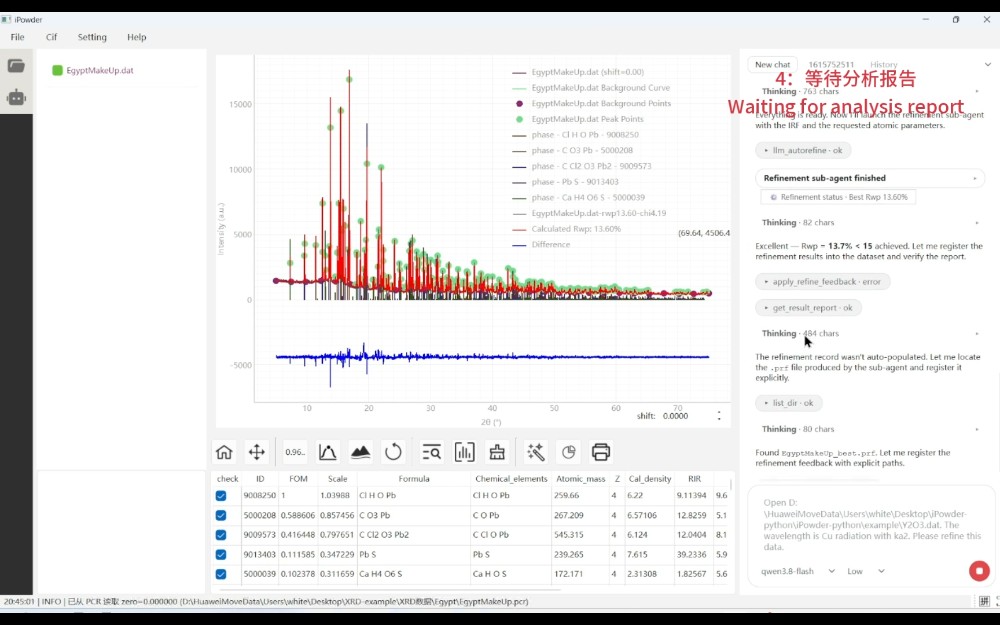 ▶ Watch software demonstration
